
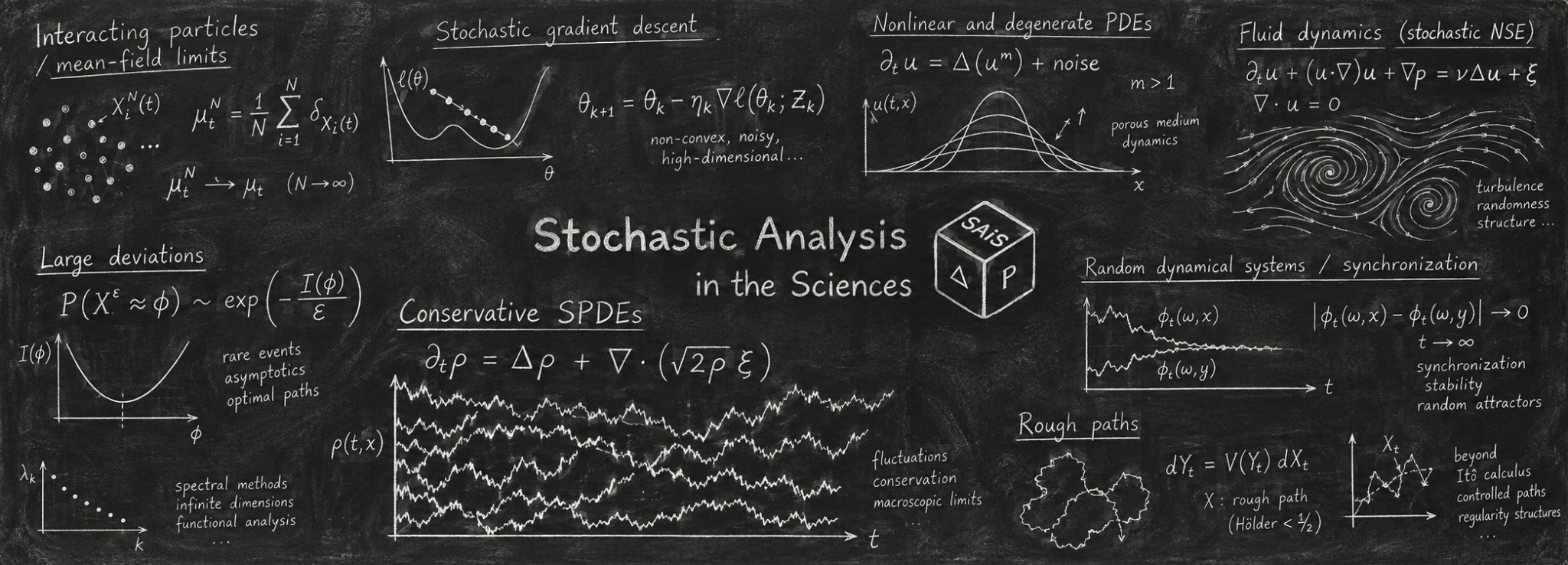
Our research mission
We study how fluctuations reshape strongly nonlinear systems and develop analytical and structure-preserving numerical methods that connect microscopic randomness, continuum equations, and learning and sampling algorithms.
Stochastic Analysis in the Sciences (SAiS) develops mathematical methods for complex systems shaped by randomness, nonlinearity and interactions across scales. Based jointly at TU Berlin and the Max Planck Institute for Mathematics in the Sciences in Leipzig, the group studies nonlinear PDEs, stochastic PDEs, stochastic dynamics and structure-preserving numerical methods.
Our work addresses conservative and singular SPDEs, equations with irregular coefficients, random dynamical systems, synchronization and regularization by noise, and scaling limits of interacting particle systems. Applications range from non-equilibrium statistical mechanics and fluctuating hydrodynamics to stochastic fluid dynamics, sampling and the mathematical foundations of machine learning. By combining analysis, probability and computation, we seek universal structures that connect microscopic randomness with effective continuum descriptions and reliable algorithms.
Recent highlights
-
Revised preprint: Probabilistically Strong Solutions to Stochastic Euler Equations
Version 2 of the Gess–Lasarzik preprint, posted on 4 November 2026.
-
New preprint: Long-time behaviour and bifurcation analysis of a non-reciprocal two-species aggregation-diffusion system on the torus
Benjamin Gess and Paul Nikolaev study two interacting species on the one-dimensional torus. They prove exponential relaxation for weak self-interactions and, under spectral and nondegeneracy assumptions, obtain periodic patterns through a Hopf bifurcation. An explicit cubic coefficient determines how the second spatial harmonic affects the direction and stability of the bifurcating branch.
-
New preprint: Dirichlet form approach to stochastic thin-film equations
Benjamin Gess, Felix Otto and Max Sauerbrey use Dirichlet forms to construct stochastic thin-film dynamics in one space dimension. They establish existence and uniqueness for the evolution of probability laws and uniform tightness of spatial approximations. For a simplified model, they identify energy solutions and prove convergence of approximations via Mosco convergence.
-
Fluctuations in Continuum: mean-field limits and machine learning, 19–23 July 2027
Paul Nikolaev and Benjamin Gess are organising a conference on mean-field limits and machine learning at TU Berlin, 19–23 July 2027. Registration opens on 1 February 2027.
Research programme
Mathematical challenges
Main fields of application
Selected projects
View all projects and affiliations →
Locations
SAiS is one research group based at two locations.


Funding and networks




Work with us
We welcome unsolicited applications, student enquiries and visitor enquiries.