

Dennis Chemnitz
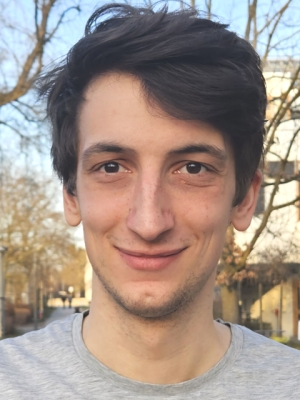
Dr. · Postdoctoral Researcher
TU Berlin and ETH Zurich
Research profile
Dennis Chemnitz studies random dynamical systems, stochastic fluid dynamics and the mathematics of machine learning. His work uses Lyapunov exponents and stability theory to investigate noisy oscillators and stochastic-gradient methods, and analyses mixing at the Batchelor scale for white-in-time fluid flows.
Research areas
Stochastic Dynamics · Stochastic Fluid Dynamics · Machine Learning
Five research keywords
random dynamical systems · stochastic fluid dynamics · stochastic gradient descent · Lyapunov exponents · mixing
Contact and links
Academic links
Curriculum vitae
| Date | Appointment / education |
|---|---|
| May 2025–present | Postdoctoral researcher at ETH Zurich; current funded SAiS researcher in the CoScaRa project at TU Berlin. |
| Apr 2025 | PhD in Mathematics, Freie Universität Berlin / Berlin Mathematical School, supervised by Dr. Maximilian Engel. Thesis: Stability of Random Dynamical Systems in Noisy Oscillators with Shear and in Stochastic Gradient Descent; summa cum laude. |
| Oct 2021–Jan 2025 | Scientific assistant at Freie Universität Berlin, funded by Priority Programme SPP 2298, Theoretical Foundations of Deep Learning. |
| Sep 2021 | MSc in Mathematics, Freie Universität Berlin. |
| Mar 2019–Sep 2021 | Student research assistant / scientific assistant at Freie Universität Berlin and Technische Universität Berlin, funded by CRC 910, Control of Self-Organizing Nonlinear Systems. |
| Aug 2020 | BSc in Mathematics, Freie Universität Berlin. |
| Apr 2016–Mar 2019 | Student teaching assistant, Freie Universität Berlin. |
Awards and grants
| Date | Award / grant |
|---|---|
| Aug 2024 | Start-up grant of Priority Programme SPP 2298. |
| Nov 2020 | Bachelor Prize of the Berlin Mathematical Society. |
Publications
This catalogue contains all publications by the member, including work from before joining SAiS. Journal versions and preprints are maintained as one record per scientific work.
-
Stochastic Flows with Strong Shear – Part I: Strong Completeness and Set Attractors
Preprint · 2026-10-05. This work studies strong completeness and set attractors for stochastic flows with strong shear, including how rapid radius-dependent rotation can prevent the existence of a global flow.
-
Mixing at the Batchelor Scale for White-In-Time Flows
We consider the mixing properties of solutions to the advection-diffusion equation of a white-in-time velocity field on the 2-dimensional torus with four forced modes. As the diffusivity parameter goes to zero, we show that the almost-sure exponential dissipation rate stays bounded from…
-
A Dynamical Systems Perspective on the Analysis of Neural Networks
In this chapter, we utilize dynamical systems to analyze several aspects of machine learning algorithms. As an expository contribution we demonstrate how to re-formulate a wide variety of challenges from deep neural networks, (stochastic) gradient descent, and related topics into dynamical statements.…
-
Characterizing Dynamical Stability of Stochastic Gradient Descent in Overparameterized Learning
For overparameterized optimization tasks, such as those found in modern machine learning, global minima are generally not unique. In order to understand generalization in these settings, it is vital to study to which minimum an optimization algorithm converges. The possibility of having…
-
Positive Lyapunov Exponent in the Hopf Normal Form with Additive Noise
Published · Communications in Mathematical Physics 402, 1807–1843 (2023). We prove the positivity of Lyapunov exponents for the normal form of a Hopf bifurcation, perturbed by additive white noise, under sufficiently strong shear strength. This completes a series of related results…
-
The conditioned Lyapunov spectrum for random dynamical systems
Published · Annales de l’Institut Henri Poincaré B 61(3), 1845–1877 (2025). We establish the existence of a full spectrum of Lyapunov exponents for memoryless random dynamical systems with absorption. To this end, we crucially embed the process conditioned to never being absorbed, the…
Current SAiS projects
CoScaRa project
Funded postdoctoral researcher in Priority Programme 2410.
Talks and posters
| Date | Talk / poster |
|---|---|
| Jun 2026 | Invited talk, SIAM Conference on Optimization, Edinburgh, UK. |
| May 2026 | Contributed talk, HYP 2026, Stuttgart, Germany. |
| Feb 2026 | Invited seminar talk, RWTH Aachen University, Germany. |
| Jan 2026 | Invited seminar talk, University of Konstanz, Germany. |
| Nov 2025 | Invited talk, Workshop on Random Dynamical Systems, Freie Universität Berlin, Germany. |
| Jul 2025 | Invited talk, Workshop on Random Dynamical Systems, PDEs, and Stochastic Analysis, University of Maryland, College Park, USA. |
| May 2025 | Invited talk, SIAM Conference on Applications of Dynamical Systems, Denver, USA. |
| Feb 2025 | Invited seminar talk, Technical University of Munich, Germany. |
| Nov 2024 | Invited talk, SPP internal workshop, Tutzing, Germany. |
| Oct 2024 | Invited seminar talk, Postgraduate Online Probability Seminar, online. |
| Oct 2024 | Invited seminar talk, NCTS (Taiwan) Webinar on Nonlinear Evolutionary Dynamics, online. |
| Jun 2024 | Invited seminar talk, University of Amsterdam, Netherlands. |
| May 2024 | Invited seminar talk, Georgia Tech, Atlanta, USA. |
| Mar 2024 | Poster, Workshop on Stochastic Analysis, EPFL, Lausanne, Switzerland. |
| Feb 2024 | Invited seminar talk, Max Planck Institute for Mathematics in the Sciences, Leipzig, Germany. |
| Nov 2023 | Invited talk, SPP internal workshop, Tutzing, Germany. |
| Aug 2023 | Invited talk, International Congress on Industrial and Applied Mathematics (ICIAM), Tokyo, Japan. |
| Jun 2023 | Invited talk, Berlin Mathematical School student seminar “What Is?”, Berlin, Germany. |
| Feb 2023 | Invited talk, Berlin Mathematical School student conference, Berlin, Germany. |
| Sep 2022 | Invited talk, Annual Meeting of the German Mathematical Society, Berlin, Germany. |
| Aug 2022 | Contributed talk, Workshop on “Critical transitions and nonautonomous bifurcations”, near Burghausen, Germany. |
| Apr 2022 | Invited talk, Workshop on “Pólya urns, stochastic approximation and quasi-stationary distributions: new developments”, Bath, UK. |
| Mar 2022 | Invited seminar talk, NCTS (Taiwan) Webinar on Nonlinear Evolutionary Dynamics, online. |
Teaching
| Term | Course / role |
|---|---|
| Winter 2022/23 | Teaching assistant, Functional Analysis I. |
| Winter 2020/21 | Teaching assistant, Dynamical Systems I. |
| Winter 2018/19 | Student teaching assistant, Logic and Discrete Mathematics for Computer Scientists. |
| Summer 2018 | Student teaching assistant, Analysis II. |
| Winter 2017/18 | Student teaching assistant, Analysis III. |
| Summer 2017 | Student teaching assistant, Analysis II. |
| Winter 2016/17 | Student teaching assistant, Probability Theory I. |
| Summer 2016 | Student teaching assistant, Analysis II. |